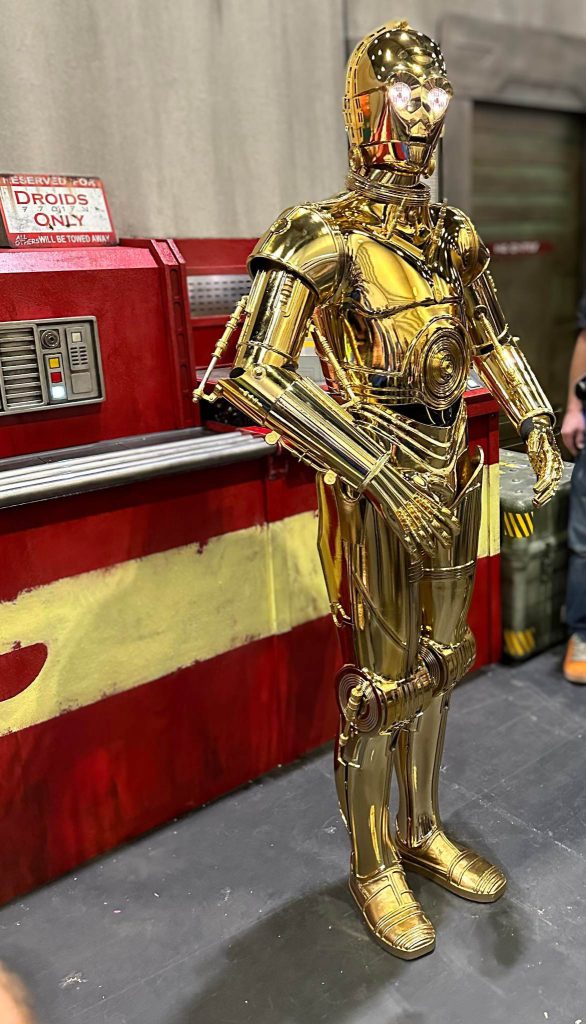
Hey! So, its been a while but I figured its about time I started getting things back on track and what better way than to put one foot in-front of another and just get started. Again.
When creating my favourite protocol droid I tried a number of different ways to create the footshells and I’m still experimenting! I started with printing a set in pla+. At the time I thought slicing the footshell midway around the ankle would be a good idea so I could fit poppers and add some elasticated strapping so the back effectively snapped to the front shell. All that happened is the back wants to move up and down along the plane which I sliced and its annoying. I still think I could make it work but there is not much room for poppers anyway so perhaps a non-starter. The shells do look nice however having benefitted from being vac metalised like the rest of the suit.
I was never quite happy with the quality of my pla+ shells, the prints had small gaps which required filling, sanding and they were incredibly rigid. From here I figured I would try something different, making a mould of sorts and then vac forming….this is still a work in progress as it took a while finding someone with the experience of vac forming. Who knows maybe one day I’ll buy or make my own vac former…..the idea is on hold pending an imminent house move.
Next up I came across a set of rubber feet supplied by another maker – I thought this would be a winner but on arrival and opening the box I quickly saw they wouldn’t work out. The quality was questionable having been cast from a fibreglass suit, they were most definitely not sized as described and would by no means survive going in a vacuum chamber as the rubber was of inconstant thickness in areas. Top tip for potential builders here; learn from my mistakes and avoid recasts….especially if you wish to wear a suit. Its highly unlikely any parts will fit and the amount of time you’ll need to make good the suit you may as well invest in 3d printing or outsourcing it (if you can) to someone which will not only give you a more customised scale suited to you but much easier parts to work with and achieve a better finish. This and files are out there for free which have been created in mind for someone to wear the parts or use as a static display….most recasts these days are made from a display piece only such as a Don Post statue – so you’d be on the back foot trying to engineer something to make it wearable!
Back to the drawing board, I had thought of abs or petg prints for the purpose of making a mould or ‘buck’ to vac form shells but then I thought about TPU….for anyone not familiar with this it’s a filament material which resembles rubber but you can get it in different grades known as ‘shore rating’ which relates to its flexibility/rigidity.
Having a friend with a large scale direct drive 3d printer and being happy to help really spurred along the progress at this point. Within a few weeks I had a set of feet turn up on my doorstep.
Similar to the rubber shells these too wouldn’t likely survive the vac chamber process but I’d been put onto Liquitex, an acrylic based material which is semi flexible and paintable!
Liquitex is a thick acrylic paste that you can dilute with water. This helps allow it to settle in all the recessed areas and between those pesky layer lines as anyone who has printed in TPU before will know they can be difficult to sand out. After a few layers and ample drying time (consistency depending) between each layer they were ready for sanding and then some paint. Another tip for folk here is test any lacquers first on rough parts, don’t ask me how I know but the pictures speak for themselves
The last couple of images above show the finished item against vac metalised parts and whilst they are clearly not as shiny and reflective they don’t appear to be out of place or detract from the over all aesthetic. I’m very happy with the outcome anyway and they’re really comfortable. End of the day, if you the maker are happy with the things you make then does it matter what anyone else thinks? I’m building this for myself and when fully suited only fellow makers may perhaps pick up on the colour difference and start to question why.
That’s it for now, thanks for reading, I hope you found some if it useful and get in touch if ever you have any questions or just want to chat about projects!